
Did you know that the average traveler spends more than five hours researching a single trip before they ever book a flight? This massive time investment often leads to burnout before the journey begins.
Modern technology has changed the game. By using an intelligent ai trip planner, you can reclaim those lost hours. Focus on the excitement of your upcoming adventure.
We recommend Voyada, a powerful travel booking platform that simplifies complex logistics. As a partner, we may earn a commission when you use their services to organize your next getaway.
This ai travel planner offers an all in one travel booking experience. It removes the stress of juggling multiple browser tabs. Now, you can manage your entire itinerary from start to finish in just minutes.
Learning how to plan a trip with ai ensures your vacation remains seamless and efficient. Whether you crave a luxury escape or a budget-friendly road adventure, this end-to-end booking method tailors every detail to your unique style.
Key Takeaways
- Planning a single trip can eat up more than five hours of research, but smart tools cut this time dramatically.
- Voyada serves as a complete solution for modern vacation management.
- Using an integrated platform eliminates the need to manage dozens of open browser tabs.
- Our guide helps you master digital tools for a more efficient travel experience.
- You can enjoy a personalized itinerary that matches your specific preferences perfectly.
Skip the hours of research
Describe your dream trip and let Voyada’s AI plan and book it for you in minutes.
Why Travelers Are Switching to AI Trip Planning
Ever spent hours juggling browser tabs for a weekend getaway? Traditional research methods overwhelm and exhaust us. Thankfully, new technology is transforming our travel planning.
The Problem With Booking Across 10 Different Sites
Building a trip itinerary used to be a tedious task. You’d switch between various websites, from flight aggregators to local guides. This fragmented approach makes budgeting and planning challenging. In fact, U.S. travelers view an average of 277 web pages of travel content before booking a single trip — a clear sign of just how scattered the old way of planning has become.
Travel automation now centralizes your booking needs. You no longer visit ten sites. Instead, a smart trip planner handles everything, saving you hours and avoiding common booking errors.
What an AI Travel Planner Actually Does
An AI travel assistant is your personal concierge, tailored to your travel style. It analyzes your preferences to offer personalized suggestions. Whether you seek luxury or affordability, it adapts to your desires instantly.
The top AI travel apps create a seamless schedule for you. Use a free trip planner to organize your days, ensuring a smooth journey. Learning to use AI for travel planning makes your vacation planning effortless. Let an AI vacation planner manage the details, so you can enjoy the journey.
How to Plan a Trip With AI: Step by Step
How planning a trip with Voyada works
Smart Recommendations
Itineraries matched to your interests.
Book Your Flight
Top flights for your dates, ready to compare.
Customize Your Trip
Mix and match services to fit your plans.
Reserve Your Stay
Find the perfect place to stay.
Local Rides & Guides
Airport transfers and trusted local services.
Insurance & Visa
Coverage and entry requirements, sorted.
Trip Management
All your bookings in one place, anytime.
Skip the steps entirely
Just tell Voyada about your trip — it plans and books the whole thing for you.
You just chat — Voyada walks you through each step.
Learning to plan a trip with AI is key to stress-free travel in 2026. Advanced technology simplifies the process, moving beyond manual research. It offers a smarter way to explore the world.
This approach streamlines the journey from idea to booking. It works for solo travelers and group trips alike. These tools provide the necessary structure for a successful trip.
Describe Your Trip in Plain Language
The process starts with natural language processing. This lets you converse with your travel assistant as you would a friend. Simply type or use voice input to share your dream vacation with an AI like Voyada.
Share your destination, activities, and travel style preferences. The AI captures these to offer tailored recommendations that align with your interests.
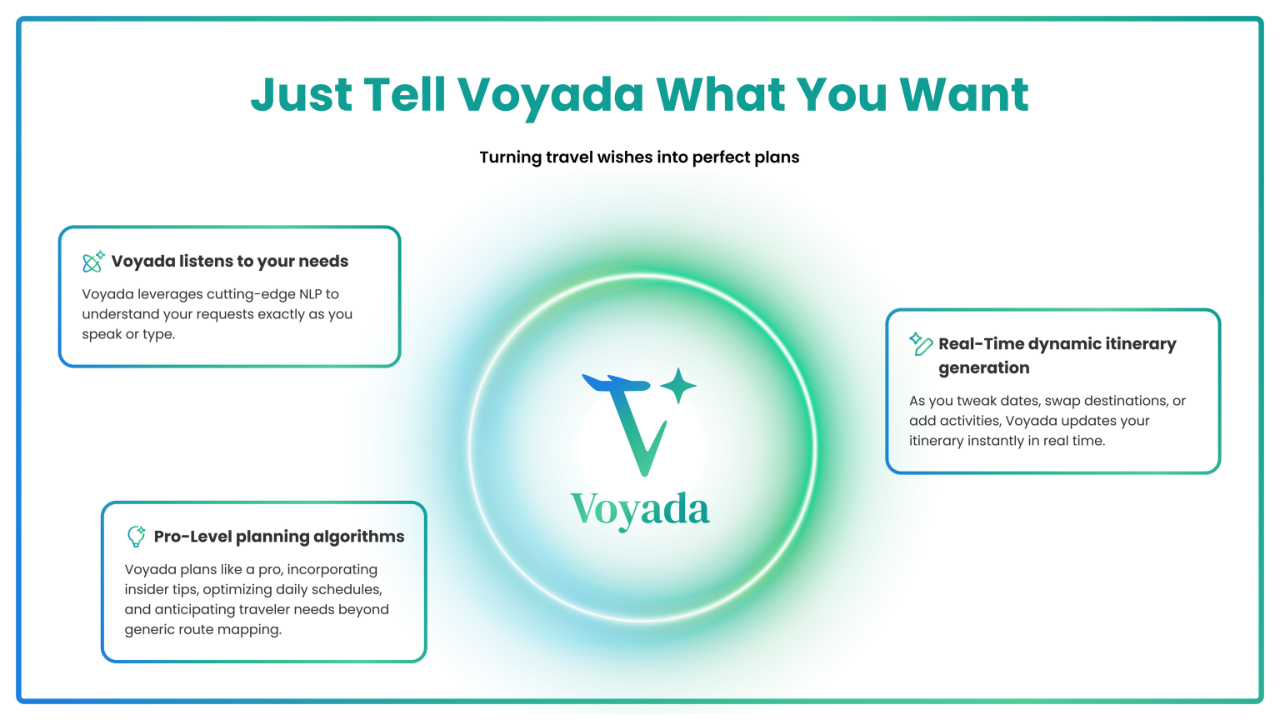
Not sure how to phrase it? Try prompts like these:
- “Plan a 7-day Italy trip for two under $3,000, focused on food and history, flying from New York.”
- “Build a relaxed 10-day Japan itinerary with three nights in Tokyo and a day trip to Hakone.”
- “Find a beach-and-culture mix in Greece for a family of four in late June.”
Let the AI Build Your Itinerary
After inputting your preferences, the AI generates your itinerary instantly. It creates a detailed, automated plan covering all trip aspects.
This includes flights, hotels, local transportation, tours, and event tickets. You don’t have to worry about missing a detail. The system organizes your trip in a single, cohesive view.
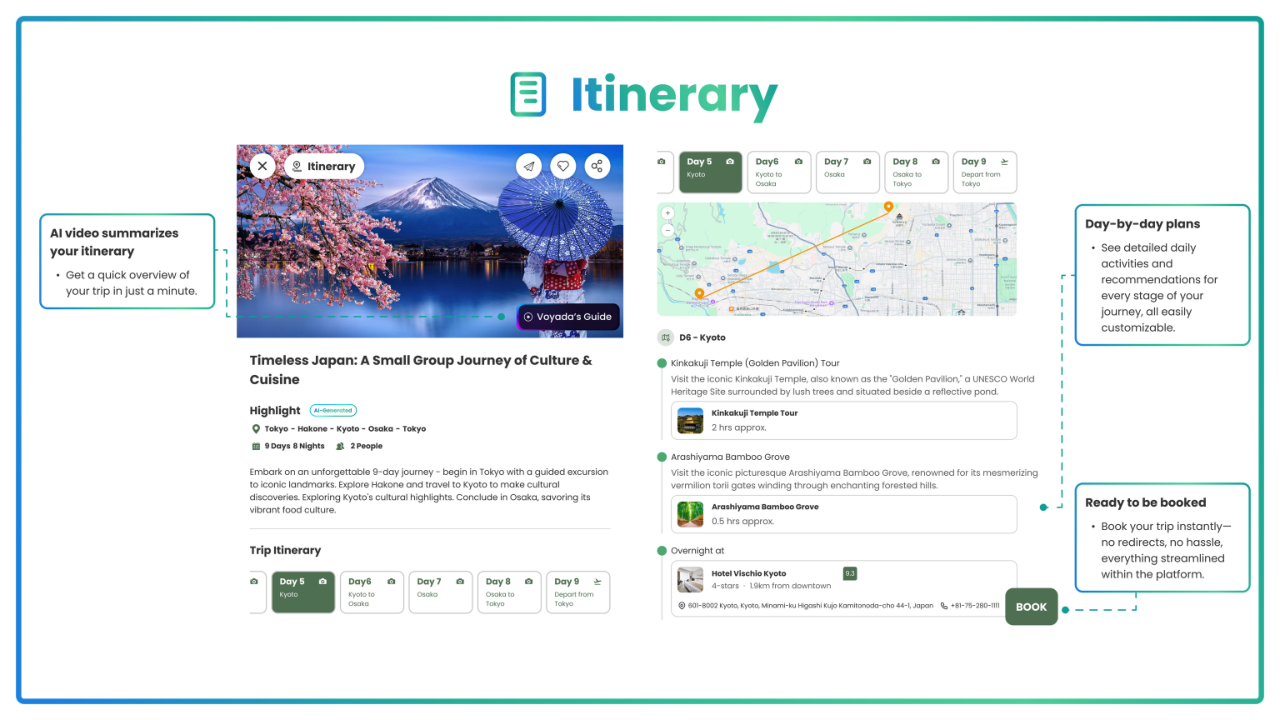
Adjust Dates, Destinations, and Pace in Real Time
Flexibility is a major advantage of AI trip planning. You can easily adjust your plans, including dates, destinations, or trip pace in real time.
This is very useful for complex multi-city trips. Your itinerary planner updates automatically. This ensures your schedule remains smooth, even if you decide to stay longer in a favorite city.
Compare Flights and Hotels for the Best Value
Securing the best deals is easy with an online trip planner. You can compare different flight and hotel bundles to find the best value for your budget.
Using these tools for planning ensures transparent pricing and smart suggestions. This method keeps your finances in check, allowing you to focus on the excitement of your trip.
A Reusable AI Travel Prompt Framework
First, the shortcut: Voyada is the world’s first AI travel assistant, so you don’t need to master any of this. Just tell it about your trip in plain language and follow the conversation — it asks the right questions and builds the plan for you. The framework below is for getting the most out of general-purpose AI tools.
The single biggest factor in the quality of your AI-generated plan is the quality of your prompt. A vague request gets a generic, tourist-trap itinerary; a detailed one gets a plan that feels tailor-made. Instead of memorizing example prompts, learn this simple formula and you can write a great one for any trip.
The formula: Role + Trip basics + Preferences + Constraints + Output format.
- Role: tell the AI who to be — e.g., “Act as an expert local guide for Portugal.”
- Trip basics: who’s going, from where, your dates or length, and destination(s).
- Preferences: your interests, pace, travel style, dietary needs and budget.
- Constraints: your must-haves and deal-breakers (“no early flights”, “walkable areas only”, “avoid tourist traps”).
- Output format: how you want it — “a day-by-day itinerary with morning, afternoon and evening activities and rough costs.”
Then iterate. Treat the first response as a draft, not a final answer. Ask follow-ups (“make day 3 more relaxed”, “swap in a local food market”), and try a powerful trick: ask the AI to critique its own plan — “What are the weaknesses of this itinerary, and what would a local change?” You’ll be surprised how much it improves.
Copy-and-Paste AI Travel Prompts
To get you started, here are seven ready-made prompts you can paste into any ai trip planner and adapt to your trip. Just swap in your own details.
- Destination ideas: “Suggest 5 destinations for a 7-day trip in May for a couple who love hiking and food, flying from Chicago, with a mid-range budget. Explain why each fits.”
- Full itinerary: “Build a detailed 5-day itinerary for Lisbon for two adults who love history, seafood and sunsets. Include a day-by-day plan with morning, afternoon and evening activities and rough costs.”
- Budget breakdown: “Estimate a realistic total budget for a 10-day trip to Japan for two, including flights from New York, mid-range hotels, food, transport and activities. Break it down by category.”
- Flights & timing: “Find the cheapest round-trip flight options from London to Bali in September, and tell me which travel dates are cheapest that month.”
- Foodie / offbeat: “Recommend 8 locally loved, non-touristy restaurants in Mexico City across different neighbourhoods and price points, and say what to order at each.”
- Family trip: “Plan a 6-day family trip to Orlando for two adults and two kids aged 6 and 9, balancing theme parks with rest days and a realistic daily schedule.”
- Multi-city: “Design a 2-week multi-city rail itinerary through Italy (Rome, Florence, Venice) with efficient train connections, 2–3 nights per city and a highlight for each.”
The more specific you are, the better the result. Pair these prompts with the framework above — then verify the details before you book.
Getting the Best Price With an AI Travel Planner
Securing top travel deals used to be a daunting task, but AI has revolutionized this process. No longer must you spend hours scouring the internet. AI trip planners swiftly analyze thousands of options, ensuring you pay only what’s necessary for your next journey.
Opting for a travel booking platform simplifies your journey. It consolidates your search and purchase, providing a streamlined experience. This approach not only saves time but also money, making your travel planning more efficient.
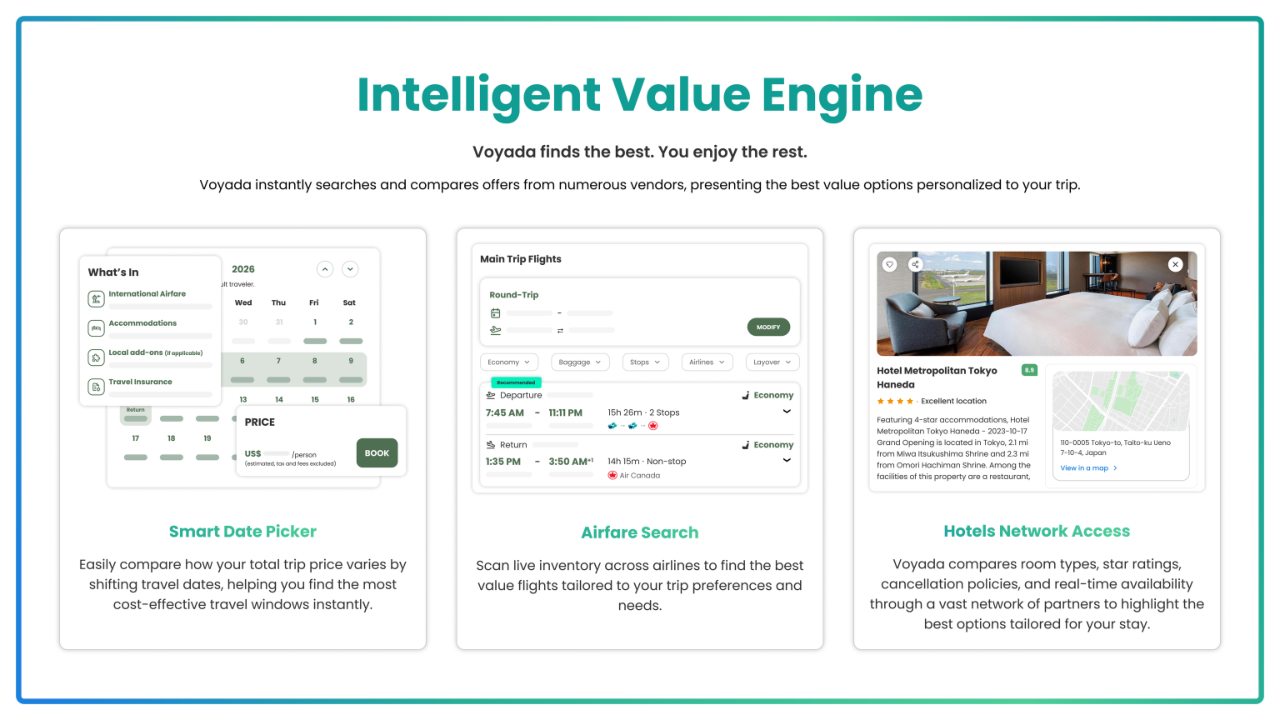
Smart Date Picker and Flexible Dates
Timing is everything when it comes to saving money. Booking flights and hotels well in advance remains the key to affordable travel. An AI travel planner keeps you on track by alerting you when prices drop.
For those with flexible plans, these tools suggest cheaper dates. A simple shift in your travel dates can lead to significant savings. The system then adjusts your itinerary to reflect these changes.
Comparing Vendors to Find the Best Price
Voyada’s Intelligent Value Engine compares vendors to find the best price. This technology simplifies the process by showing your costs clearly upfront. You’ll have a clear understanding of your expenses before making a decision.
Utilizing dynamic and real-time pricing, these platforms ensure you get the best deals. Booking flights and hotels together as a bundle is convenient. This approach streamlines your travel planning, keeping everything organized in one place.
How to Use AI to Actually Save Money on Your Trip
Used well, AI is one of the best money-saving tools a traveler has — not just for finding a cheap flight, but for optimising the whole trip. Here are the tactics that make the biggest difference.
- Compare flexible dates: ask the AI (or use a planner with a smart date picker) to show how your total cost changes if you shift your trip by a few days. Flying midweek or a week earlier can save hundreds.
- Think in total trip cost, not line items: a slightly pricier flight into a different airport can be cheaper once you add transfers and hotels. Ask for the all-in cost — flights, hotels, transport and activities together.
- Target shoulder season: ask “When is the cheapest time to visit X with good weather?” to dodge peak-season prices and crowds.
- Build a realistic budget: have AI break your budget down by category so you know where the money goes — and where to cut.
- Find free and low-cost gems: ask for free viewpoints, no-ticket attractions, happy hours and picnic spots to balance out the splurges.
This is exactly where a plan-and-book platform shines: Voyada’s Intelligent Value Engine scans live prices across airlines and a hotel network, then shows how your whole-trip cost shifts by date — so you can book the best-value window in one place rather than piecing it together yourself.
Skip the research marathon — plan your whole trip in minutes
Voyada’s AI turns your ideas into a day-by-day itinerary with real flights, hotels and prices — all bookable in one place.
How to Plan Any Type of Trip with AI
The way you use AI should change with the kind of trip you’re taking. Here’s how to get the most from it for each style of travel.
- Family trips: ask for kid-friendly pacing, rest days, stroller- and nap-friendly routes and family restaurants. Have AI balance must-see sights with downtime so nobody melts down.
- Solo travel: lean on AI for safety tips, sociable hostels or tours, walkable neighbourhoods and solo-friendly dining, and ask it to flag areas to avoid at night.
- Group trips: use a planner with shared, collaborative itineraries so everyone can add ideas and vote — and ask AI to suggest activities that suit a range of interests and budgets.
- Multi-city and complex routes: this is where AI truly excels — optimising the order of cities, transport connections and nights per stop so you’re not backtracking.
- Budget and backpacking: ask for hostel areas, cheap eats, free activities and the most cost-effective transport passes.
- Luxury and special occasions: request fine dining, standout stays, private guides and once-in-a-lifetime experiences worth the splurge.
- Accessible travel: AI can help find step-free routes, accessible hotels and attractions, and dietary-friendly restaurants — just be specific about your needs and always confirm the details directly.
Planning Tools That Make AI Travel Easier
The latest travel apps simplify complex logistics, making travel enjoyable. They use advanced ai travel assistants to reduce planning stress. These tools anticipate your needs, streamlining your journey.
Voice and Text Input
Modern tools support natural language processing, allowing voice or text input. You can update plans easily, whether at the airport or home. This makes your travel itinerary feel personalized.
Forget navigating complex menus. Just describe your ideal trip, and the ai itinerary generator will take care of it. This smart trip planner adjusts to your preferences instantly, keeping your schedule flexible.
Group Planning and Shared Itineraries
Planning a trip with friends can be overwhelming. New features simplify this process. Platforms like Voyada manage group planning and shared itineraries in one place. You can track expenses in multiple currencies, ensuring everyone is on the same page.
An automated itinerary keeps everyone informed of changes in real-time. This collaborative approach makes planning stress-free. Everyone can contribute, making the final itinerary a group effort.
Travel Insurance and Visa Checks
Safety and compliance are key for international travel. A good ai vacation planner includes visa eligibility checks. Always cross-check the latest entry and visa rules on the official U.S. State Department international travel pages.
Top services also offer travel insurance and 24/7 expert chat for peace of mind. If plans need adjusting due to unexpected events, you have support. An integrated ai travel itinerary generator ensures your trip is organized and secure.
The Best AI Travel Planning Tools in 2026
“AI trip planner” can mean very different things, and the right choice depends on how far you want it to take you — from suggesting ideas to actually booking the whole trip. Broadly, the tools fall into three categories.
- General AI chatbots (ChatGPT, Google Gemini, Claude, Microsoft Copilot) are brilliant for brainstorming destinations, drafting itineraries and answering questions. But they mostly generate text, can show outdated or invented details, and can’t reliably book flights or hotels on their own.
- Dedicated AI planners (such as Mindtrip, Layla and Wonderplan) add maps, visual itineraries and some booking links — a step up, though booking is often partial and sends you elsewhere to finish.
- All-in-one plan-and-book platforms (like Voyada) go the full distance: they plan and book flights, hotels, tours, tickets, local rides and more in one place, with real, live, bookable prices — no redirects and nothing to redo.
Here’s how the categories compare at a glance:
| Tool | Type | Real-time prices? | Books flights + hotels + tours together? | Free? |
|---|---|---|---|---|
| Voyada | All-in-one plan & book | Yes — live | Yes — everything, no redirects | Yes |
| ChatGPT / Gemini / Claude / Copilot | General chatbot | Limited or none | No — suggests only | Free & paid tiers |
| Mindtrip | Dedicated planner | Partial | Partial (limited booking) | Free |
| Layla | Dedicated planner | Partial | Partial | Free & paid |
For pure ideas, a chatbot is free and fine. But if you want to go from a vague wish to a booked, day-by-day trip without juggling ten tabs, a dedicated trip planning ai that books for real — like Voyada — saves the most time and hassle.
What Sets a Great AI Trip Planner Apart From a Basic One
Not all AI travel tools are built the same. The pitfalls travelers run into almost always come from general-purpose chatbots — and they are exactly the problems a purpose-built platform like Voyada is designed to solve.
Real, Bookable Options — Not Invented Ones
General-purpose chatbots sometimes “hallucinate,” inventing a hotel, a route, or an opening time that does not exist, or quoting prices that are months out of date. This is where Voyada pulls ahead: instead of guessing, it draws on live vendor inventory, so every flight, hotel, and ticket it shows is real, current, and ready to book. What you see is what you can actually reserve — no surprises at checkout.
Visa and Entry Help Built In
Many AI tools leave you to sort out the paperwork alone. Voyada includes a built-in visa eligibility checker that flags what you are likely to need before you go. As a final step for any international trip, it is always smart to confirm the official details — U.S. travelers can check the U.S. State Department for entry requirements and the CDC’s Travelers’ Health service for vaccine and health notices.
It Understands Exactly What You Want
Basic tools hand back generic plans because they cannot juggle detail. Voyada is built for the opposite: the more specific you are — your budget, your travel pace, your must-see interests, and any constraints like mobility, dietary needs, or traveling with kids — the more precisely it tailors the trip to you instead of the average tourist. Tell it everything, and it delivers a plan that feels custom-made.
From Plan to Booking: Closing the “Last-Mile” Gap
Here’s the frustration almost everyone hits with AI trip planning: you spend an hour chatting with a chatbot, end up with a beautiful day-by-day itinerary… and then have to go and book every single piece of it yourself — opening a flight site, three hotel sites, a tours site — only to find the “hotel” the AI suggested is fully booked or the price was made up. The plan and the booking live in two different worlds. That’s the last-mile gap.
It matters because it’s where most of the time savings evaporate. A plan you can’t act on is just inspiration. The fix is a platform that keeps planning and booking together: real, live inventory behind every suggestion, so what you plan is genuinely available at the price shown — and you can book it in the same place.
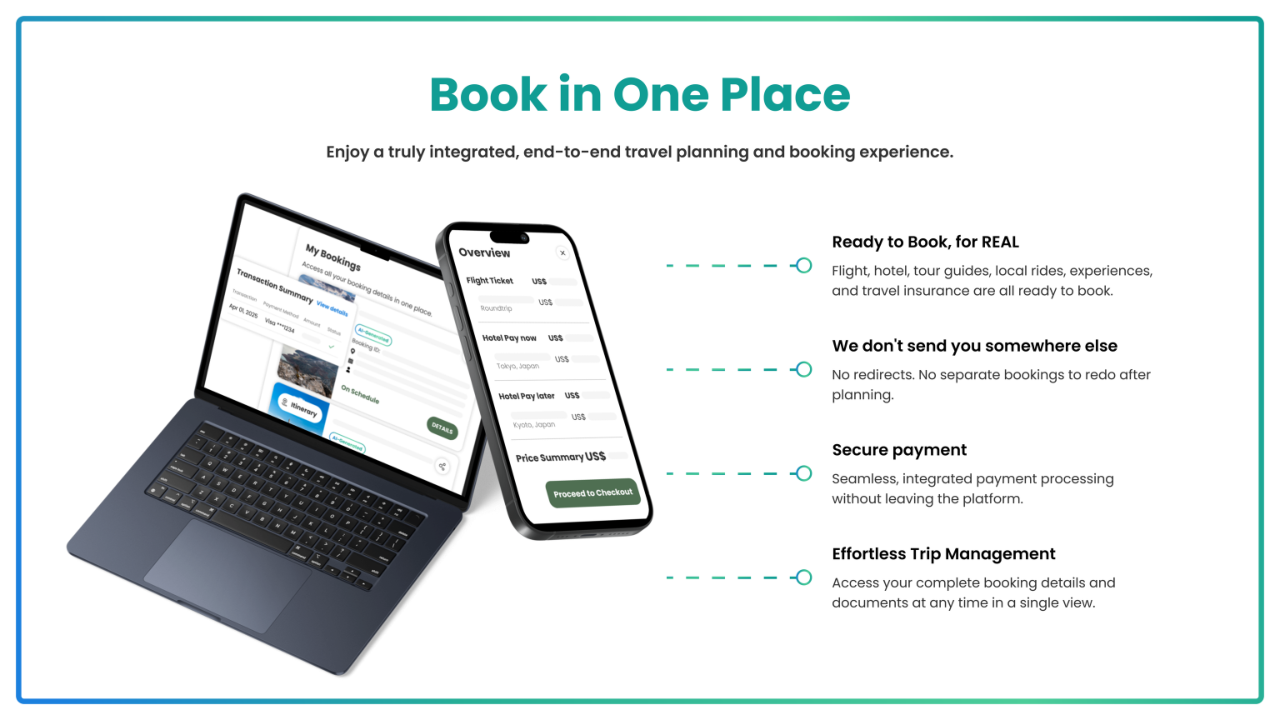
This is Voyada’s core advantage over chatbots and most planners: flights, hotels, cruises, tours, tickets, local rides, guides and insurance are all ready to book in one checkout, with no redirects and no separate bookings to redo. You go from a wish to a booked trip without ever leaving the plan.
Don’t let your itinerary die at the booking stage
With Voyada, everything you plan is ready to book on the spot — no redirects, no re-doing it on ten other sites.
Where AI Trip Planning Falls Short
AI is a fantastic starting point, but it’s not infallible — and knowing its blind spots is what separates a smooth trip from a stressful one. Watch out for these limitations:
- Hallucinations: AI can confidently invent hotels, restaurants or even attractions that don’t exist. Always confirm a place is real before you rely on it.
- Outdated information: chatbots may not know a restaurant closed, a museum’s new hours, or today’s prices. Details can be months (or years) out of date.
- No live availability or pricing: a plain chatbot can’t see whether that flight has seats or that hotel has rooms tonight — and the prices it quotes are often estimates, not real.
- Generic, touristy picks: without a specific prompt, AI defaults to the obvious big-name sights and misses the local gems.
- Missing context: public holidays, festivals, seasonal closures and local events that affect crowds, prices and availability.
None of this means you shouldn’t use AI — just that you should treat its output as a smart draft to verify, not gospel.
How to Use AI Safely: Always Verify Before You Book
The golden rule of AI travel planning is simple: trust, but verify. Run every AI plan through this quick checklist before you commit any money:
- Confirm places are real and open: search the hotel, restaurant or attraction to check it exists, is still open and has good recent reviews.
- Check prices at the source: verify flight and hotel prices directly on a booking site — don’t assume the AI’s number is current.
- Verify opening hours and closures: confirm days and hours on the official site, especially around holidays.
- Double-check visas and entry rules on official sources: only trust government or official sites for visa, passport and entry requirements — never an AI’s word alone.
- Cross-check with humans: a quick look at recent traveler reviews or a forum can catch anything the AI missed.
A platform that books from live inventory removes much of this risk, because the options it shows are real and bookable — but the verify habit is always worth keeping.
Using AI While You’re Traveling — Not Just Planning
AI doesn’t clock off once you land. Some of its most useful moments happen mid-trip, when plans change and you need answers fast.
- Re-plan on the fly: rain ruined your beach day? Ask for the best indoor alternatives nearby and have your itinerary rearranged in seconds.
- Translate anything: use AI translation apps for menus, signs and conversations — many work from your phone’s camera in real time.
- Get local recommendations on demand: “Find a great, well-reviewed dinner spot within a 10-minute walk of my hotel that’s open now.”
- Handle disruptions: flight delayed or cancelled? Ask AI to explain your options and rebooking rights, and to suggest alternative routes.
- Navigate and stay safe: get directions, transit help and quick safety guidance for your neighbourhood.
Keep your trip details in one app so any changes stay in sync — a platform with built-in trip management means your bookings and documents are all in a single view when you need them most.
A Worked Example: Planning a Trip with AI, Start to Finish
To see how it all comes together, here’s a quick, realistic example. Say you paste this prompt into a trip planning ai:
“Act as an expert local guide. Plan a 5-day trip to Portugal in October for two adults who love food, history and coastal views, flying from Boston on a mid-range budget. Give me a day-by-day itinerary with morning, afternoon and evening activities, where to stay, and a rough total cost.”
A good AI planner returns something like: Days 1–3 in Lisbon (Alfama and the castle, a pastel de nata tasting, a day trip to Sintra), Days 4–5 on the coast at Cascais (seafood lunches and clifftop walks), with a recommended neighbourhood to stay in each city, suggested flights, and an estimated all-in cost per person. From there you refine — “make day 2 more relaxed”, “add a sunset viewpoint” — and the itinerary updates in real time.
The final step is the one that matters most: turning that plan into a booked trip. With an all-in-one ai travel planner, the flights, hotels and experiences in that itinerary are ready to book on the spot — so your five-minute plan becomes a real, confirmed trip in one place.
The Future of AI Travel Planning
AI trip planning is evolving fast, and 2026 marks a real shift — from tools that suggest to tools that act. The big move is toward agentic AI: assistants that don’t just draft an itinerary but can carry out the whole task for you, comparing real options and booking flights, hotels and activities on your behalf, with your approval.
We’re already seeing early versions: search engines adding agentic booking modes, and travel platforms letting you go from a plain-language wish to a booked, end-to-end trip. Expect these systems to get better at understanding nuance, remembering your preferences across trips, adjusting plans in real time as prices and availability change, and handling the messy logistics travelers hate.
The takeaway for today: the tools that already close the gap between planning and booking — the all-in-one platforms — are a preview of where all of travel is heading. Learning to use them now puts you ahead of the curve.
Is AI Trip Planning Right for You?
Choosing to use technology for your next trip depends on your travel style and the trip’s complexity. Modern tools can save time and reduce stress, perfect for those who want to plan a vacation with ai.
Ideal Scenarios for Digital Assistance
An online trip planner shines when organizing a complex multi-city trip. These platforms allow voice search travel features to build your itinerary on the move. The best ai travel apps simplify managing logistics for quick weekend escapes or busy international tours.
When Personal Expertise Matters
Some trips need a human touch to meet your specific standards. For high-end luxury bookings or trips with complex medical or legal needs, a professional agent is best. While online planning is easy, human experts offer peace of mind for unique events.
Learning to plan a trip with ai is a skill that grows with each booking. Use a free trip planner to test these systems before your next big adventure. Begin your step by step trip planning today to see the time you’ll save. Whether you opt for a multi city trip planner or a simple tool, your next journey is just a click away.
Ready to plan your whole trip in minutes?
Let Voyada’s AI build and book your entire itinerary — flights, hotels, and more — in one place.
Frequently Asked Questions
How do I use natural language processing to start my journey?
Starting with natural language processing is as easy as talking to a knowledgeable friend. With an ai travel planner like Voyada, simply type or speak your desires. For instance, say “I want a 10-day multi-city trip through Japan with a focus on local food.” The engine interprets your needs and begins the trip planning process instantly. It turns a vague idea into a detailed itinerary.
Can I really book flights and hotels together in one place?
Yes, and it’s a game-changer. An all-in-one travel booking platform lets you book flights and hotels together easily. This eliminates the need to visit multiple websites. Travel automation simplifies the process, organizing your booking in a single interface.
How does machine learning improve my personalized travel itinerary?
An ai vacation planner uses machine learning to adapt to your unique style. It analyzes data to provide personalized recommendations that fit your budget and interests. The more you interact, the better it suggests hidden gems, making it a top ai travel app for a unique experience.
Is an ai itinerary generator better at finding deals than manual searching?
Most likely! An ai itinerary generator tracks real-time pricing and analyzes trends across thousands of vendors in seconds. It compares costs while you sleep, ensuring you get the best value. This acts as a high-speed vacation planner that surfaces the best value for your dates.
Can I manage a complex multi-city trip with an automated itinerary?
Absolutely. A multi-city trip planner powered by AI handles complex logistics quickly. If you need to change a destination or adjust your pace, the automated itinerary updates your schedule and bookings in real time. This keeps your travel planner accurate and stress-free.
What additional support does an ai travel assistant provide?
An ai travel assistant acts as your 24/7 digital concierge. It helps plan an itinerary online and offers voice search travel for adjustments. It also checks visa eligibility and provides integrated travel insurance options. It’s the most reliable way to plan a vacation with ai.
Is there a way to find a free trip planner that is actually powerful?
You’re in luck! Many advanced platforms offer a free trip planner version. You can build a travel itinerary and explore destinations at no cost. These free tools are a great way to learn how to use ai for travel planning before booking.
What is the best AI trip planner?
There’s no single “best” — it depends on how far you want it to go. General chatbots like ChatGPT, Gemini and Claude are great for ideas and draft itineraries, dedicated planners like Mindtrip add maps and some booking, and all-in-one plan-and-book platforms like Voyada take you from idea to a fully booked trip in one place. For a start-to-finish experience, the all-in-one option saves the most time.
Which AI is best for travel planning — ChatGPT, Gemini, or Claude?
All three are capable. ChatGPT and Claude write detailed, well-structured itineraries, and Claude is especially strong on budgets and logistics; Gemini has the edge for real-time information thanks to its Google integration. Whichever you choose, they suggest rather than book — so you’ll still need a way to turn the plan into reservations, and you should verify every detail.
Can AI book flights and hotels for me?
General chatbots can’t reliably book on their own — they suggest options, often with estimated prices. To actually book, you need a platform connected to live inventory. An all-in-one travel booking platform like Voyada plans and books flights, hotels, tours and more together in one checkout, so you don’t have to redo everything on separate sites.
Does AI make mistakes when planning trips?
Yes. AI can “hallucinate” — confidently inventing hotels, restaurants or details that don’t exist — and it may use outdated information about prices, hours or closures. That’s why you should treat any AI itinerary as a smart draft and verify the key details (that places are real, open and correctly priced) before booking.
Is AI travel planning safe and reliable?
It’s reliable for inspiration and structure, and safe as long as you verify. Confirm prices on booking sites, check opening hours on official pages, and — crucially — only trust official government sources for visa and entry rules. Using a platform that books from real, live inventory reduces the risk of fake or unavailable options.
What is the best free AI trip planner?
Many strong tools are free. ChatGPT, Gemini and Claude all have capable free tiers for building itineraries, and dedicated planners like Mindtrip and Voyada let you plan (and, with Voyada, book) at no cost. Start free to learn how to use ai for travel planning, then choose the tool that matches how hands-off you want the booking to be.