


Table of Contents
TogglePlanning a trip to Europe is exciting, but estimating the true cost can be confusing — especially after price increases across 2023–2025. Broad, undated averages (like “$1,000–$5,000”) understate real-world expenses for many itineraries, so use the updated ranges below as starting points and check links to current sources when you budget.
How Much Does a Trip to Europe Cost? Quick Reference
| Duration | Budget (per person) | Mid-Range | Luxury |
|---|---|---|---|
| 7 days | $1,200–$1,800 | $2,500–$4,000 | $6,000–$12,000 |
| 10 days | $1,700–$2,500 | $3,500–$5,500 | $9,000–$18,000 |
| 14 days | $2,200–$3,500 | $3,500–$6,000 | $6,500–$12,000+ |
Estimates per person from the US, including round-trip flights. Scroll down for the full category-by-category breakdown.
Several factors drive costs: the time of year you travel, which countries and cities you visit, your travel style (budget vs. mid-range vs. luxury), and whether international flights are included. Below are updated, region-aware starting estimates for typical trips — each should be adjusted for your trip length, planned activities, and recent price data (see planning tips and sources in the article). For official, up-to-date visitor information, see Visit Europe, the European Travel Commission’s official site.
Key Takeaways
- Realistic starting ranges (2026): Western Europe — expect higher daily minimums (often $120–$180 per day for basic budget travel); Eastern Europe — significantly cheaper on many items.
- Destination and travel style dramatically affect totals: a one-week city trip in Paris or Oslo will cost substantially more than the same length in Prague or Budapest.
- Time of year matters — peak season (June–Aug, holidays) drives up flights, hotels, and attractions.
- Include flight costs and new entry-related fees (ETIAS, updated Schengen visa rates) when calculating total trip costs.
- Use a dated budget calculator or checklist (updated for 2026 data) to avoid underfunding your trip.
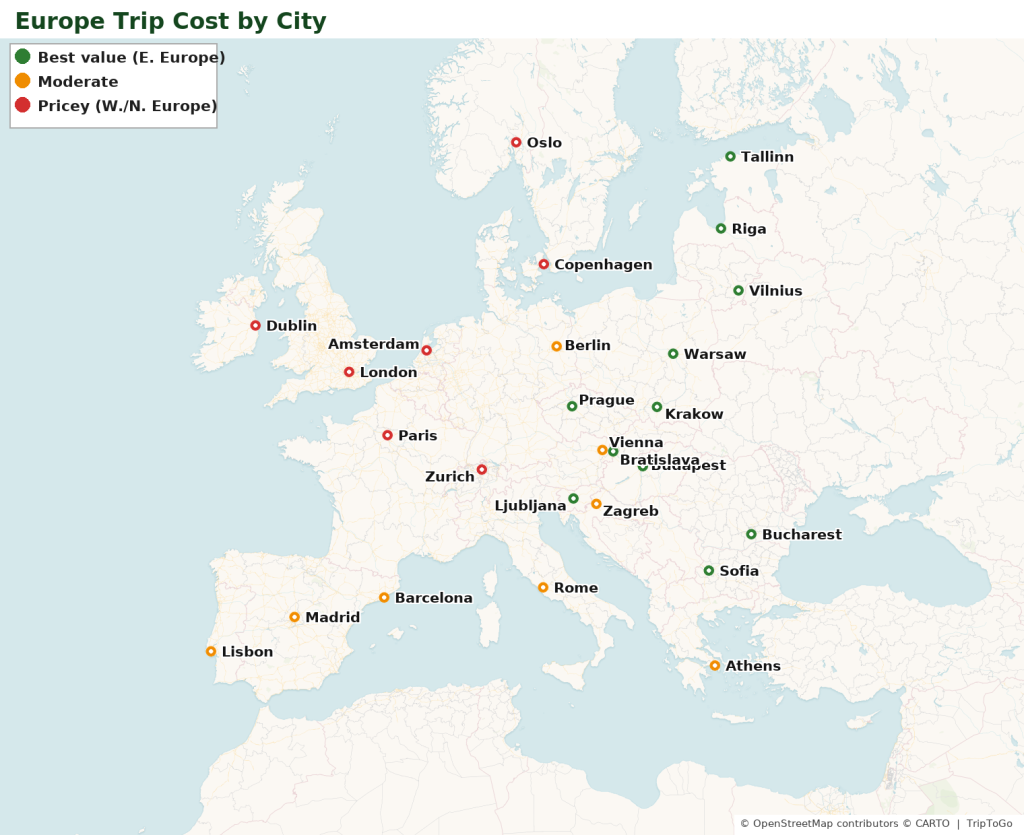
Europe Trip Cost by Country (2026): Cheapest to Priciest
Costs swing wildly by country — the single biggest lever on your budget. Here is a sortable breakdown of daily spending across Europe, from the best-value east to the priciest north and west.
| Country | Cost tier | Budget €/day | Mid-range €/day |
|---|---|---|---|
| Bulgaria | Best value | 40 | 65 |
| Romania | Best value | 40 | 65 |
| North Macedonia | Best value | 40 | 60 |
| Hungary | Best value | 50 | 80 |
| Poland | Best value | 50 | 80 |
| Slovakia | Best value | 50 | 80 |
| Czechia | Best value | 55 | 90 |
| Lithuania | Best value | 55 | 95 |
| Latvia | Best value | 55 | 95 |
| Estonia | Best value | 60 | 100 |
| Slovenia | Best value | 60 | 100 |
| Portugal | Moderate | 60 | 105 |
| Croatia | Moderate | 65 | 110 |
| Greece | Moderate | 65 | 115 |
| Spain | Moderate | 70 | 125 |
| Germany | Moderate | 80 | 140 |
| Italy | Moderate | 80 | 145 |
| Austria | Moderate | 85 | 145 |
| France | Pricey | 90 | 160 |
| Netherlands | Pricey | 95 | 170 |
| Ireland | Pricey | 95 | 170 |
| UK (London) | Pricey | 100 | 190 |
| Denmark | Pricey | 110 | 195 |
| Norway | Pricey | 120 | 215 |
| Iceland | Pricey | 130 | 230 |
| Switzerland | Pricey | 140 | 250 |
Per person, per day, excluding international flights (food, lodging, local transport and sights). Approximate 2026 ranges; relative ordering follows Eurostat comparative price levels.
✈️ TripToGo Travel Deals
Get notified about great travel deals
Hand-picked flight, hotel and destination deals, straight to your inbox. No spam, unsubscribe anytime.
🎉 Thank you for subscribing!
You’re all set — the best travel deals are on their way.
Sample Europe Trip Budgets (2 Weeks)
| Travel style | 2-week trip (per person, incl. US flight) |
|---|---|
| Budget (hostels, trains, self-catering) | $1,800 – $3,000 |
| Mid-range (3-star hotels, restaurants) | $3,500 – $6,000 |
| Luxury (4–5 star, private transfers) | $6,500 – $12,000+ |
Europe Trip Cost: Key Facts
What does an average Europe trip cost? A typical 2-week mid-range trip runs about $3,500–$6,000 per person, including transatlantic flights.
How much per day? Plan roughly €90–160 a day mid-range (excluding flights) — as little as €40–70 in Eastern Europe and €120–250 in Switzerland, Norway or Iceland.
Cheapest countries: Bulgaria, Romania, Hungary and Poland.
Most expensive: Switzerland, Norway, Iceland and Denmark.
Cheapest time to go: November to March (outside the holidays); summer adds 20–50% to flights and hotels.
Don’t forget ETIAS: once ETIAS launches, U.S. and other visa-exempt visitors need a €20 ETIAS authorization (valid three years) to enter the Schengen Area — it is not a visa.
Skip the 10 tabs — book your whole Europe trip in one place
Voyada’s AI vacation planner prices flights, hotels and experiences together, so you can book the trip you just budgeted in minutes.
Plan my vacation →Voyada is an AI travel platform TripToGo partners with; we may earn a commission.
Understanding the Variables That Affect Europe Trip Costs

The cost of traveling in Europe depends on several predictable variables; knowing these helps you estimate a realistic budget and avoid being underfunded. Post‑2022 inflation and 2026 price adjustments mean baseline costs are higher than older guides—use the region- and season-specific guidance below when you plan your trip.

Seasonal Price Fluctuations Throughout the Year
Peak season (roughly June–August, plus major holidays) drives the highest prices for flights, hotels, and many attractions — expect a clear premium compared with shoulder and off‑season. Shoulder seasons (April–May and September–October) usually offer the best balance of weather and lower costs, while off‑season (November–March) can save money but may mean reduced opening hours for some sites.
Tip: for many routes the peak premium on flights and hotels can be 20%–50% or more vs. shoulder/off months — check current fare indices and hotel rates for your target cities and book early for peak windows.
Duration of Your Stay and Its Impact on Costs
Trip length directly affects totals: more days means more nights, meals, and intra‑city transport. However, longer stays can unlock savings — weekly or monthly apartment rentals and long‑stay discounts on some platforms lower the per‑day accommodation cost. For multi‑city itineraries, compare point‑to‑point fares vs. rail passes to see which saves money for your specific route and trip length.
Decision rule: if you plan many long train hops across countries in a short span, a rail pass may be cost‑effective; if you move slowly or visit only two cities, individual tickets often cost less. Always price both options with current 2026 fares.
Travel Style and Comfort Level Preferences
Your style — backpacker, mid‑range, or luxury — is one of the largest determinants of cost. To guide planning, use region-specific per‑day baselines (examples for 2026): Eastern Europe budget travel often starts lower, Western Europe budget minimums commonly start around $120–$180 per day; mid‑range travel in Western Europe typically ranges higher. Tailor these baselines for specific cities (Paris, London, Oslo are well above average).
What each style commonly includes:
- Backpacker/budget: hostel or low‑cost private room, public transport, street food/markets, free walking tours.
- Mid‑range: 3★ hotels or private rentals, a mix of eateries (casual + one nicer meal), local trains or occasional short flights.
- Luxury: 4–5★ hotels, fine dining, private transfers, premium tours and experiences.
Actionable steps: prioritize a short list of must‑see cities, book high‑cost elements (flights, flagship hotels) early, and shift lower‑cost days or destinations into your itinerary to balance the budget across the trip.
Flight Costs to Europe from the United States
Flight costs are one of the biggest variables when you travel to Europe — and 2026 price patterns mean you should plan conservatively. Round-trip transatlantic fares commonly range from roughly $400 on deep-sale/off‑peak dates up to $1,000 or more during peak season and for popular destinations; medians vary by route and time of booking. Always check current airfare indices when you estimate your total trip cost.

Average Airfare Prices by Season and Destination
Seasonality matters: summer (June–August), major holidays, and school breaks push prices highest. As a rule of thumb, expect fares in peak season to be 20%–50% higher than shoulder or off‑season for the same route. Popular hubs (London, Paris, Rome) often show the highest demand and fares; flying into less-busy airports or booking open‑jaw itineraries can lower the total cost.
Example (illustrative, check live prices): round-trip to London — off‑peak ~$450–$600, shoulder ~$600–$900, peak $800–$1,200+. Use these as ballpark figures and verify with current searches for your travel dates.
Average Round-Trip Flight Costs by US Departure Region
| Departure Region | Off-Peak | Shoulder Season | Peak (Jun–Aug) |
|---|---|---|---|
| East Coast (NYC, BOS, DC, PHL) | $380–$600 | $550–$800 | $800–$1,200 |
| Southeast (ATL, MIA, CLT) | $420–$650 | $580–$850 | $850–$1,300 |
| Midwest (ORD, DFW, MSP) | $450–$700 | $600–$900 | $900–$1,400 |
| Mountain / Southwest (DEN, PHX, LAS) | $500–$750 | $650–$950 | $950–$1,500 |
| West Coast (LAX, SFO, SEA) | $520–$800 | $680–$1,000 | $1,000–$1,600 |
East Coast travelers consistently get the lowest transatlantic fares. West Coast departures typically run $100–$200 more per ticket due to longer routing. Always check open-jaw options — flying into one city and out of another can reduce the overall round-trip fare.
Budget Airlines vs. Full-Service Carriers
Budget carriers (and low-cost transatlantic options) often list lower base fares, but extras (checked bags, seat selection, food, priority boarding) add up quickly. When comparing, add typical ancillary fees to the base fare to get an apples‑to‑apples price. Full-service carriers include more in the ticket (checked bag on many routes, seat included, often better change/cancellation options), which can make them the better value for comfort or if you need flexibility.
Tip: run a side‑by‑side comparison of the total cost (base fare + baggage + seat + change fees) for any budget carrier to avoid surprises.
Proven Tips for Finding Cheaper Transatlantic Flights
Use these practical strategies to lower flight costs:
- Be flexible with travel dates — midweek departures and red-eye/early‑morning flights are often cheaper.
- Search with multi‑city or open‑jaw options to reduce backtracking and sometimes lower fares.
- Use fare comparison tools and set alerts with fare-comparison tools and check airline sites directly.
- Book at the right time: while exact “best booking windows” vary by route, for transatlantic travel it’s often wise to start monitoring prices 3–6 months out and book once a price dip appears for your target dates.
- Factor in baggage, seat, and change fees when choosing budget airlines — what looks cheap might not be after add-ons.
Finally, when calculating your total Europe trip cost, include the likely flight price range for your itinerary and season rather than relying on a single low fare; that reduces the risk of underbudgeting.
When to Go: Month-by-Month Cost Guide
Timing your trip is one of the most effective cost levers available. Flights and hotels in July or August typically run 30–50% higher than the same trip in May or September. Here is what each period means for your budget.
| Month | Flights | Hotels | Crowds | What to Expect |
|---|---|---|---|---|
| Jan–Feb | Low | Low | Low | Cheapest overall; cold, some seasonal closures |
| Mar–Apr | Medium | Medium | Low–Medium | Good value; spring weather building; Easter can spike briefly |
| May | Medium | Medium | Medium | ✓ Sweet spot — best balance of price, weather, and crowds |
| Jun | High | High | High | Peak season begins; book well in advance |
| Jul–Aug | Peak | Peak | Peak | Most expensive; 30–50% above shoulder season rates |
| Sep | Medium | Medium | Medium | ✓ Sweet spot — summer weather lingers, prices drop sharply after Labor Day |
| Oct | Medium | Low–Medium | Low | Good value; autumn scenery, cooler temperatures |
| Nov–Dec | Low–Medium | Low | Low | Very cheap overall; Christmas markets worth the trip (book early for Dec) |
The bottom line: May and September offer the best combination of value and experience — full ferry and tour schedules, reasonable weather, and hotel and flight prices running 20–35% below peak summer.
Accommodation Expenses Across Europe
Where you stay is one of the largest line items in your europe trip cost. Accommodation options range from shared hostel dorms and budget guesthouses to vacation rentals and high‑end hotels, and prices vary widely by region and city — especially in 2026 where inflation and demand have pushed up nightly rates in many Western European destinations.
Hostels and Budget Lodging Options
Hostels and budget guesthouses remain the cheapest option, but 2026 typical ranges are higher than older guides suggest. Expect dorm beds and basic private rooms roughly:
- Eastern Europe (e.g., Kraków, Budapest): $15–$40 per night
- Western Europe (e.g., Lisbon, Berlin): $25–$60 per night
- High‑cost cities (Paris, London, Scandinavia): $40–$80+ per night
Look for hostels with kitchen access and free breakfast to lower your daily food costs. Check review filters, cancellation policy, and whether the price shown includes taxes and city tourist fees.
Mid-Range Hotels and Vacation Rentals
Mid‑range hotels and self‑catered vacation rentals offer more comfort but wide price dispersion by city. Typical 2026 nightly ranges:
- Eastern Europe mid‑range: $50–$120 per night
- Western Europe mid‑range: $120–$250 per night (Paris and London commonly start around €150–€300 / $160–$320+ for many mid‑range properties)
- Scandinavia / Switzerland mid‑range: $180–$350+ per night
Vacation rentals can be better value for groups or longer stays — search for weekly discounts and factor in cleaning fees and service charges when comparing to hotels.
Luxury Hotels and Boutique Stays
Luxury hotels and boutique properties deliver premium service and amenities. Expect nightly rates commonly in these 2026 ranges:
- Major Western European capitals: $300–$700+ per night
- Scandinavian and Swiss luxury: often $400–$900+ per night
Luxury stays often include extras (concierge, breakfast, better cancellation terms) that can matter if you value flexibility and comfort.
How to choose and save: compare region‑specific prices rather than relying on a single global average; book refundable or flexible rates during volatile periods; and consider mixing accommodation styles (a few nights in a pricier city hotel, then cheaper guesthouses or rentals) to balance your total trip cost.
Daily Food and Dining Costs
Food is a major daily expense when you travel europe — and prices in 2026 are higher than many older guides suggest. Meal and grocery costs vary strongly by country and city, so plan per‑day food budgets by region and travel style rather than using a single global number. (All currency conversions should be dated when you publish; examples below use approximate 2026 ranges.)
Street Food and Casual Dining Expenses
Street food and casual dining remain the most budget‑friendly ways to eat, but per‑meal minimums have risen. Typical per‑meal and per‑day ranges in 2026:
- Eastern Europe (Prague, Budapest, Kraków): street meals $4–$10; casual restaurant meals $6–$15.
- Western Europe (Lisbon, Berlin, Barcelona): street meals $6–$15; casual cafe meals $10–$25.
- High‑cost cities (Paris, London, Oslo): street or takeaway $8–$20; casual meals often start $15–$35.
Example tip: many cities offer lunchtime prix fixe or market stalls where you can eat a filling meal for far less than dinner prices — use lunch specials to save on food costs.
Restaurant Meals and Local Cuisine Pricing
Mid‑range restaurant meals vary by location. Updated 2026 illustrative ranges:
- Eastern Europe mid‑range dinner: $10–$25 per person.
- Western Europe mid‑range dinner: $25–$50 per person (Paris mid‑range dinners commonly €30–€50 / $32–$54+).
- High‑end dining: $80–$200+ per person in top restaurants across major capitals.
When budgeting, decide how many “splurge” dinners you want and balance them with cheaper meals or self‑catering days.
Daily Food Budgets by Travel Style (2026 examples)
- Backpacker / Budget: Eastern Europe $25–$50/day; Western Europe $70–$120/day (street food, groceries, cheap cafes).
- Mid‑Range Traveler: Eastern Europe $50–$100/day; Western Europe $120–$200/day (mix of casual restaurants, one nicer meal, occasional takeaways).
- Comfort / Luxury: $200+/day depending on city and dining choices.
Grocery Shopping and Self‑Catering Savings
Self‑catering is one of the best ways to reduce food costs, especially on longer trips or for families. Grocery shopping lets you control meal costs and sample local produce markets. When comparing savings, remember rentals may add cleaning/service fees — factor those into nightly vs. self‑catered comparisons.
Practical saving tips: cook breakfast and one meal at your rental, eat lunch at market stalls or prix fixe lunches, avoid restaurants in heavily touristy areas, and drink tap water where safe. These tactics can lower your daily food total substantially while still letting you enjoy local cuisine.
Transportation Within Europe

Getting around Europe offers many choices — trains, budget flights, buses, ferries, and rental cars — and each has different cost and time tradeoffs. For accurate budgeting in 2026, compare current ticket prices, include ancillary fees, and factor in travel time between places when planning your route.
Transportation costs vary greatly by mode and by route. Below are practical, dated examples and decision rules to help you choose the most cost‑effective way to move between cities and countries.
Train Travel and European Rail Passes
Train travel is often the most comfortable and scenic way to travel europe, especially for intercity trips inside regions. For some itineraries, a rail pass (like the Eurail Global) can save money and time — but not always. In 2026 the Eurail Global pass entry prices start at around €300+ for short duration adult passes (verify current fares for your travel dates). For point‑to‑point long high‑speed journeys, individual advance‑purchase tickets are frequently cheaper.
Decision rule: if you’ll make many long cross‑border hops in a short period (several high‑speed trips in 7–10 days), model a pass vs. ticket total; if you travel slowly or only visit two or three cities, buy individual tickets and book early for the best fares.
Budget Airlines for Inter-City Travel
Budget carriers (Ryanair, easyJet, Wizz Air and others) can offer very low base fares for short flights, but add baggage, seat selection, and airport transfer costs to understand the true price. Typical short intercity fares in 2026 can start under $20–$40 one‑way on deep sales, but realistic one‑way costs with baggage and higher‑season demand commonly fall in the $40–$120 range.
Tip: use multi‑airport searches and include transfer time/costs; sometimes a longer train or bus ride is cheaper and faster once you factor airport transfers and waiting time.
Car Rentals, Gas, and Driving Costs
Renting a car gives flexibility for rural routes and multi‑stop road trips, but total costs include rental fees, mandatory insurance or excess waivers, fuel, tolls, parking, and possible one‑way drop fees. In 2026, expect typical compact rental rates from ~$30–$80/day in many countries (season and city pickup affect price), plus fuel and insurance. Scandinavia and Switzerland often have higher fuel and rental costs.
Note city rules: many European cities have congestion zones or low‑emission zones with daily charges and fines for noncompliance — factor these into your cost planning.
Quick Comparison & Practical Tips
- Estimate all-in travel costs (ticket + baggage + transfers + time) when comparing trains vs flights.
- Book trains and budget flights early for the best advance fares; check refund/cancellation rules for flexibility.
- For multi‑country fast itineraries, test a rail pass vs. individual tickets with current 2026 prices — don’t assume a pass is always cheaper.
- Factor in new entry/administrative costs (ETIAS, Schengen visa fees) which can affect multi‑country planning and total trip cost.
When you calculate your total trip cost, include the transportation type for each leg, plus realistic ancillary fees and local transfer times — this prevents underbudgeting and helps you choose the fastest, cheapest, or most scenic way to travel depending on your priorities.
Attraction Tickets and Entertainment Expenses
Attractions and entertainment can add up fast — museums, guided tours, and special experiences often have separate fees that should be budgeted into your trip. Planning which paid attractions you’ll visit and which free activities you’ll use to balance your days will keep your total trip cost under control.
Museum Passes and City Discount Cards
City passes and museum bundles can offer strong savings if you plan to visit several paid sites in one city. Many passes include public transportation and fast‑track entry, which also saves time. Evaluate a pass by listing the attractions you want and comparing the pass price to individual entry costs — if the pass covers most of your must‑see museums, it’s usually worth it.
Example decision rule (illustrative): if the combined cost of the top three attractions you plan to visit is within ~75% or more of the pass price, the pass is likely a good deal. Check up‑to‑date 2026 prices for Paris Pass, Rome tourist cards, and local museum bundles before you buy.
Paid Attractions vs. Free Activities
Paid attractions — major museums, cathedrals, and landmark sites — often charge €10–€30+ per entry in 2026 (some special exhibits or tower climbs cost more). Typical examples: Louvre, Colosseum, Sagrada Família and similar flagship sites commonly fall in that range; premium guided experiences or skip‑the‑line tours can push prices higher.
Balance ticketed sights with free options: public parks, markets, neighborhood strolls, many churches, and free walking tours let you experience culture without high tickets. Look for museum free days or discounted evening hours — many institutions offer lower‑cost entry at specified times.
Tours and Guided Experiences
Tours add context and often make attractions more memorable, but they vary widely in price. Free walking tours (tip‑based) are available in most major cities; small‑group specialty tours (food tours, wine tastings, private guide days) typically range from $30–$150+ depending on length and exclusivity.
Booking tip: compare group size, inclusions (entrance fees, tastings), and cancellation policy. Pre‑booking popular guided experiences can save money and guarantee availability, especially in peak season.
Regional Cost Differences: Western vs. Eastern Europe

Europe’s cost landscape is uneven — some countries and cities are significantly more expensive than others. In 2026 you should plan with regional baselines in mind: Western Europe generally has much higher daily minimums than Eastern Europe, and Northern Europe (Scandinavia/Switzerland) is typically the priciest. Choosing where to spend your days is one of the most effective ways to control your total trip cost.
Expensive Destinations
Countries with high living costs — Switzerland, Norway, and much of Scandinavia — lead Europe’s price list. Western European capitals (Paris, London) also sit well above continental averages. Typical examples in 2026:
- Meal prices: mid‑range restaurant dinners in major Western/Scandinavian cities commonly run €25–€50+ (Paris mid‑range dinners often €30–€50 / $32–$54+).
- Drinks: a beer in Oslo/Zurich can cost €8–€10, while coffee and snacks are also pricier.
- Accommodation: mid‑range hotels in these markets frequently start at $150–$300+ per night, and luxury properties are substantially higher.
Moderate-Cost Countries
Countries like France (outside Paris), Germany, Spain, and Italy have a mix of price points — you can find both expensive city centers and more affordable neighborhoods. In these countries you’ll typically see:
- Mid‑range dinners: roughly €15–€35 in many cities (city center vs neighborhood restaurants varies).
- Accommodation: broad range from budget guesthouses to mid‑range hotels $80–$200 per night depending on city and season.
Tip: visiting smaller cities or suburbs often cuts both food and hotel costs without sacrificing experiences.
Budget-Friendly Options
Eastern Europe (Poland, Hungary, Romania, parts of the Balkans) and some parts of Portugal offer much lower daily costs. Representative 2026 ranges:
- Meals: casual local meals frequently €3–€12; mid‑range dinners €8–€25.
- Accommodation: budget hostels and guesthouses often start in the $15–$50 range in many cities; mid‑range hotels are substantially cheaper than Western European equivalents.
- Example price gap: a beer in Prague might be €2–€3 versus €8–€10 in Oslo — a 3–4x difference on common items.
How to use this: if you want to keep the overall trip cost down but still visit top Western sites, consider splitting your itinerary — fewer nights in the priciest cities (Paris, Oslo, Zurich) and more nights in nearby lower‑cost cities to average down your per‑day spend.
Average Daily Cost by Country
The table below covers accommodation, food, local transport, and one or two paid activities per day. International flights are not included.
| Country | Budget/day | Mid-Range/day | Comfortable/day | Notes |
|---|---|---|---|---|
| Romania | $40–$55 | $60–$90 | $110–$170 | Cheapest overall; underrated scenery |
| Poland | $45–$65 | $70–$100 | $130–$190 | Best-value capital cities in Europe |
| Serbia / Balkans | $45–$65 | $75–$110 | $130–$190 | Very affordable; rapidly developing tourism |
| Hungary | $50–$70 | $80–$115 | $140–$200 | Budapest rivals Paris at a fraction of the cost |
| Portugal | $60–$80 | $95–$140 | $160–$240 | Best value in Western Europe |
| Greece | $65–$85 | $100–$150 | $180–$280 | Mainland cheap; islands add 30–50% |
| Spain | $75–$100 | $120–$170 | $200–$300 | Menu del día cuts daily food costs significantly |
| Germany | $80–$110 | $130–$190 | $210–$320 | Munich runs 15–25% pricier than Berlin |
| Italy | $85–$115 | $140–$200 | $230–$350 | South cheaper than north; Venice is the priciest city |
| France | $90–$120 | $150–$220 | $250–$380 | Paris adds 30–40% vs. the rest of the country |
| Austria | $95–$125 | $155–$220 | $250–$370 | Vienna slightly more affordable than Amsterdam or Paris |
| Netherlands | $100–$135 | $160–$230 | $270–$400 | Amsterdam among the priciest European cities |
| United Kingdom | $110–$150 | $180–$260 | $300–$450 | London adds 40–50% vs. the rest of the UK |
| Norway | $130–$170 | $210–$300 | $350–$500+ | Among the most expensive countries in Europe |
| Switzerland | $140–$185 | $220–$320 | $380–$550+ | Consistently the most expensive European destination |
Suggested planning baseline (2026): Western Europe baseline daily minimums often fall in the $120–$180 range for basic budget travel; Eastern Europe baseline minimums are commonly in the $50–$90 range. Use those as starting points, then adjust for city, season, and your travel style when calculating your total trip costs.
Europe Trip Cost by City: Within-Country Price Differences
Country-level averages mask large swings within the same destination. A trip built around London, Paris, and Venice will cost considerably more than one covering Edinburgh, Lyon, and Naples — even if the countries are the same. Here is how major cities compare.
| City | Country | Budget/night (hotel) | Mid-range meal | Notes |
|---|---|---|---|---|
| Lisbon | Portugal | $60–$100 | $12–$20 | Best-value Western European capital |
| Porto | Portugal | $55–$90 | $10–$18 | 10–15% cheaper than Lisbon |
| Barcelona | Spain | $80–$140 | $15–$25 | Menu del día cuts lunch costs sharply |
| Madrid | Spain | $75–$130 | $14–$22 | Slightly cheaper than Barcelona |
| Paris | France | $130–$250 | $20–$35 | 30–40% above French national average |
| Lyon | France | $75–$120 | $14–$22 | Far cheaper than Paris; excellent food scene |
| Rome | Italy | $90–$160 | $15–$28 | Mid-range; avoid tourist-trap restaurants near major sights |
| Venice | Italy | $130–$240 | $20–$40 | Most expensive Italian city; day-trip from cheaper base |
| Naples | Italy | $55–$95 | $10–$18 | 20–30% cheaper than Rome; gateway to Amalfi |
| Berlin | Germany | $75–$130 | $13–$22 | Most affordable major German city |
| Munich | Germany | $100–$180 | $18–$30 | 15–25% pricier than Berlin |
| Amsterdam | Netherlands | $120–$220 | $18–$30 | One of Europe’s priciest capitals |
| London | UK | $130–$250 | $20–$40 | 40–50% above UK national average |
| Edinburgh | UK | $80–$140 | $14–$24 | Significantly cheaper than London |
| Prague | Czech Republic | $50–$90 | $9–$16 | Excellent value; one of Europe’s most popular destinations |
| Budapest | Hungary | $45–$80 | $8–$15 | Thermal baths and Danube at Eastern European prices |
| Kraków | Poland | $40–$70 | $7–$14 | Consistently one of Europe’s best-value city breaks |
Practical takeaway: Routing your trip through one or two budget-friendly Eastern European cities can offset the cost of a few nights in Paris or London. A two-week itinerary mixing Kraków, Prague, and Vienna costs roughly the same as seven nights in Paris alone.
How Much Does a Europe Trip Cost for Different Budget Levels

Europe suits every budget, but 2026 price shifts mean the old one-size-fits-all daily figures understate real costs — especially in Western Europe. Below are region‑aware daily budgets for three travel styles with examples of what each covers; use these as starting points and adjust by city, season, and trip length.
Backpacker / Budget
Notes: budget travel in Eastern Europe is considerably cheaper than in Western Europe. Western European backpacker minimums have risen and are typically higher than older guides suggest.
- Eastern Europe example (Prague, Budapest, Kraków): $25–$50 per day — dorm or basic private room, public transport, street food/markets, free walking tours.
- Western Europe example (Lisbon, Berlin, Barcelona): $70–$120 per day — hostel dorm or inexpensive private, groceries/market meals, some casual cafes, public transport.
Mid‑Range Traveler
This is the most common planning category for travelers who want comfort without luxury.
- Eastern Europe mid‑range: $60–$120 per day — 2–3★ hotels or private rentals, a mix of casual and sit‑down meals, public/local trains.
- Western Europe mid‑range: $120–$250 per day — 3★ hotels or well‑located vacation rentals (many Western European mid‑range hotels in 2026 start near €150/night in major cities), two restaurant meals/day, occasional taxis or intercity trains.
Comfort / Luxury Travel
For travelers who prioritize convenience, service, and premium experiences:
- Eastern Europe comfort/luxury: $150–$300+/day — higher‑end hotels, private transfers, guided experiences.
- Western Europe comfort/luxury: $250–$500+/day — 4–5★ hotels, fine dining, private tours, higher activity budgets (Paris, London, Oslo and Swiss cities trend to the top end).
Practical warning: the old “under $60/day” backpacker rule is no longer safe for planning Western European trips in 2026; underbudgeting risks forced compromises or debt. Also include one‑time costs (return flights, visas/ETIAS fees, travel insurance) and a 10–20% contingency when calculating your total trip cost.
Group Tour vs. Solo Travel: How the Costs Actually Compare
One cost that rarely appears in standard Europe trip calculators is the solo traveler premium. When you plan independently, several expenses are higher per person than when costs are distributed across a group. Here is a straightforward comparison.
| Cost Item | Solo / Independent | Group Tour |
|---|---|---|
| Accommodation (14 nights, mid-range) | $1,800–$2,800 + single supplement | Included at group rate |
| Single room supplement | +$300–$700 (30–50% above double rate) | N/A — eliminated |
| Guided city tours | $40–$90 per tour, per person | Included or group-discounted |
| Skip-the-line entry fees | Full retail price | Bulk group rates |
| Intra-Europe transport | Individual booking, full fare | Pre-negotiated group rates |
| Trip planning time | 15–25 hours | 0 |
The single room supplement alone — the extra charge hotels apply when a room is occupied by one person rather than two — can add $300–$700 to a two-week trip. Group tours eliminate this entirely. For travelers targeting Western European highlights (Paris, Rome, Barcelona, Prague) in a single trip, the all-in per-person cost of a group tour is often comparable to, or lower than, building the same itinerary independently once accommodation, guides, and skip-the-line passes are factored in.
Sample Europe Trip Cost Calculations
Sample budgets help turn abstract per-day numbers into real planning targets. Below are updated 2026‑style illustrative budgets for common trip lengths and styles. Each sample shows two scenarios where helpful (realistic Western Europe vs. lower‑cost Eastern Europe) and explicitly notes whether flights are included. Before finalizing your plan, check live prices for your dates — these ranges are starting points, not guarantees.
One‑Week Paris Trip — realistic 2026 example
Flights: round‑trip transatlantic flights not included in the estimate below; expect $400–$1,000+ depending on season, route, and booking window.
Option A — Western Europe (Paris) — conservative estimate (flights excluded):
- Accommodation (7 nights, mid‑range): $1,100–$2,200 (many Paris mid‑range hotels in 2026 start around €150–€300 / $160–$320+ per night).
- Food: $350–$550 (mix of casual lunches, one or two nicer dinners — Paris mid‑range dinners commonly €30–€50).
- Local transportation: $60–$120 (metro passes, occasional taxi or rideshare).
- Attractions & tours: $150–$300 (Louvre, Musée d’Orsay, Seine cruise, one guided tour).
- Estimated total (one week, Paris, without flights): $1,660–$3,170
Option B — Lower‑cost one‑week city (e.g., Kraków/Budapest):
- Accommodation: $200–$420 (7 nights in budget or modest mid‑range hotels).
- Food: $150–$280.
- Transport & attractions: $80–$160.
- Estimated total (one week, Eastern Europe, without flights): $430–$860
Two‑Week Multi‑Country Itinerary — illustrative 2026 ranges
These two‑week examples assume travel between several cities (mix of trains and budget flights). Include intercontinental flights separately.
- Western Europe two‑week conservative: Accommodation $1,800–$3,500; food $900–$1,600; transportation (trains, budget flights, local) $400–$900; attractions $400–$800. Estimated total (without transatlantic flights): $3,500–$6,800.
- Mixed itinerary (Western + Eastern mix): Accommodation $1,200–$2,200; food $600–$1,000; transportation $400–$800; attractions $300–$600. Estimated total: $2,500–$4,600.
Note: user research and market data in 2026 indicate a 10–15%+ year‑over‑year rise in many travel costs versus pre‑pandemic norms in some markets — budget conservatively and add contingency.
Month‑Long Backpacking/Slow Travel Example
For a month (30 days) of varied travel across multiple countries, cost depends heavily on region mix and travel pace.
- Eastern Europe–focused month: Accommodation $450–$900 (hostels/private budget rooms), food $600–$900, transport $300–$600, attractions $200–$500. Estimated total (excluding long‑haul flights): $1,550–$2,900.
- Western Europe–heavy month: Accommodation $1,800–$3,600 (mix of budget and mid‑range nights), food $2,100–$3,600, transport $600–$1,200, attractions $500–$1,000. Estimated total: $5,000–$9,400.
How to use these samples to build your own cost trip
- Decide trip length and your travel style (budget, mid‑range, luxury).
- Choose region mix (Western vs Eastern Europe) — that will be the biggest cost lever.
- Add estimated intercontinental flights ($400–$1,000+ round‑trip in 2026 depending on season and deals).
- Include hidden/miscellaneous costs (travel insurance, possible Schengen visa €90 if applicable, future ETIAS fee of around €20 for eligible travellers, SIM/data, and a 10–20% contingency for inflation/changes).
- Use a simple formula: (daily budget × days) + flights + intra‑Europe transport + attractions + contingency = trip total.
Want a tailored estimate? Use the downloadable budget template or our interactive calculator (recommended CTA) to swap cities, trip length, and travel style and get a personalized cost trip total for your dates.
How Much Does a Europe Trip Cost for a Family?
Family trips carry a different cost structure than solo or couples travel. The key differences: hotels require private rooms (no hostel savings), activities are charged per person at most venues regardless of age, and flights are the single largest line item for a group of four or more.
| Trip Length | Budget — Family of 4 | Mid-Range | Comfortable |
|---|---|---|---|
| 10 days | $7,000–$10,000 | $12,000–$18,000 | $22,000–$35,000 |
| 14 days | $9,000–$13,000 | $16,000–$24,000 | $28,000–$45,000 |
Estimates for 2 adults and 2 children (ages 8–14), including round-trip flights from the US East Coast.
Where families save:
- Vacation apartments cost less per person than hotel rooms and include a kitchen, which significantly reduces food costs
- Children under 18 receive free or discounted entry at most European museums and national monuments
- Shoulder season travel (May, September) cuts flights and hotels 20–35% compared to peak summer
Where family costs spike:
- Flights are the biggest expense — four seats in summer often total $3,000–$5,000+ round-trip from the US
- Guided tours and activity entry fees are per person at most venues, with limited under-12 discounts
- Families of five or more typically need two hotel rooms or a larger apartment, which increases accommodation costs substantially
Hidden and Miscellaneous Travel Expenses
Beyond flights, hotels, and meals, several “small” line items can materially change your total trip cost. Plan for these hidden and miscellaneous expenses up front so you don’t get surprised mid‑trip.
Travel Insurance and Medical Coverage Costs
Travel insurance is essential. Policies vary by age, destination, trip length, and coverage level (medical, evacuation, cancellation). In 2026, a typical comprehensive policy for a two‑week trip often ranges from about $30–$150 per person depending on age and coverage limits; younger travelers on shorter trips will be at the low end, older travelers or those wanting “cancel for any reason” protections will pay more. If you plan adventure sports or high‑risk activities, buy a policy that covers those specifically.
Tip: compare policy coverage limits for medical and evacuation (these matter most in high‑cost countries), and check whether your existing health insurance or credit‑card benefits already include some travel coverage.
Visa Fees, Entry Rules and Documentation
Entry fees and rules changed in 2026 and affect planning and cost. Important items to check now:
- Schengen visa fee: increased to €90 in June 2024 for short‑stay Schengen visas — confirm the current fee for your nationality and consulate before applying.
- ETIAS travel authorization: travelers from visa‑exempt countries to the Schengen zone will generally need ETIAS authorization; the administrative fee is around €20, and free for under-18s and over-70s, but check rollout and timing for your passport country before travel.
- Passport validity: many countries require at least 3–6 months validity beyond your planned return date — check destination rules and renew early if needed (expedited passport fees can be significant).
Budget line examples (2026, illustrative): Schengen visa €90 (~$95) if needed; ETIAS fee around €20 if required; passport expedited renewal $60–$200 depending on service level and country.
How to Avoid Losing Money on Currency and Card Fees
Three mistakes consistently cost US travelers money in Europe — none of them obvious until after the trip.
1. Airport and tourist-area currency exchange kiosks. Exchange bureaus at major European airports and train stations charge 5–10% above the mid-market rate. On a $3,000 trip, that is $150–$300 in hidden fees. Use an ATM on arrival or pay by card wherever possible.
2. Using a card with foreign transaction fees. Many standard US bank cards charge 1–3% on every international purchase. On a $4,000 mid-range trip, that quietly adds $40–$120 in fees. Use a travel credit or debit card with no foreign transaction fees — several strong options exist at no annual fee.
3. Dynamic currency conversion (DCC). When a card terminal or ATM asks whether you want to pay in US dollars instead of the local currency, always choose the local currency. The “convenient” conversion adds another 3–7% to each transaction.
Practical approach: Carry one no-fee travel card for daily spending, a debit card that reimburses ATM fees for cash withdrawals, and a small amount of local currency for day one. Notify your bank before you leave, confirm your daily ATM withdrawal limit, and increase it if needed for longer trips.
Communication: SIM Cards, eSIMs, Data Plans and Wi‑Fi
Staying connected has predictable costs. Options include local prepaid SIMs, eSIMs, short‑term international plans, or relying on Wi‑Fi. In 2026 typical short‑stay data packages run from roughly $5–$30 for small local bundles, while full multi‑country eSIM data plans for a week can be $10–$50 depending on data volume and provider.
Advice: if you need reliable data across multiple countries, compare eSIM providers and local SIM prices by country. Use Wi‑Fi for heavy downloads where secure and supplement with an affordable local/eSIM data pack for navigation and payments.
How to Stay Connected in Europe Without Overpaying
Data connectivity is a genuine trip cost — one that varies widely depending on how you handle it. The four main options each suit a different type of traveler.
| Option | Typical Cost | Best For | Drawbacks |
|---|---|---|---|
| eSIM (digital SIM) | $15–$40 for 10–15 days of data | Multi-country trips; travelers with eSIM-compatible phones | Not all phones support eSIM; some plans limit speeds after a data cap |
| Local physical SIM | $10–$25 per country | Travelers staying in one or two countries; very heavy data users | Must buy a new SIM each country; requires unlocked phone |
| International roaming add-on | $5–$15/day or $70–$100/month | Short trips or travelers who forget to plan ahead | Expensive per day; daily fee applies even on days you barely use data |
| Pocket WiFi device rental | $8–$15/day, plus deposit | Groups sharing a device; non-eSIM phones | Another device to carry and charge; limited hotspot connections |
For most US travelers on a multi-country Europe trip: a multi-country eSIM covering the EU is the most cost-effective and lowest-friction option. You activate it before departure, it covers most or all Schengen countries on one plan, and there is no physical SIM to lose or swap.
Before you leave:
- Confirm your phone is unlocked (call your carrier before the trip, not at the airport)
- Check whether your phone supports eSIM — most flagship devices released after 2020 do
- Download offline maps for every destination before departure — this eliminates 70–80% of your data usage while navigating
- Set a daily data usage alert on your phone to avoid surprise overages on any plan
Budget line item: plan for $20–$50 total for connectivity on a 10–14 day trip, regardless of which option you choose. Travelers who rely on hotel WiFi exclusively often find it unreliable for navigation between properties.
Other Miscellaneous Costs to Budget
- Airport transfers and local transport surcharges (taxi, private transfer): $10–$80 depending on city and distance.
- City tourist taxes and occupancy fees — now up to €12 a night in Barcelona and a 5% levy in Edinburgh, plus Venice’s €5–10 day-tripper fee — often charged per night by hotels or added as local taxes; range from €1–€8+ per night in many cities.
- Tips, small purchases, laundry, ATM fees — these can add $5–$20/day depending on habits.
- Sim/visa application processing or courier fees if applying from abroad — plan $10–$50 if needed.
Mandatory pre‑travel checklist (quick)
- Check passport validity (months required) and renew early if needed.
- Confirm visa/ETIAS requirements for each country on your itinerary and budget the official fees (e.g., Schengen €90 as of June 2026).
- Buy travel insurance with adequate medical/evacuation limits for your destination and activities.
- Decide on communication: eSIM vs local SIM vs Wi‑Fi and budget accordingly.
- Add a 10–20% contingency to your trip budget for miscellaneous and inflationary surprises.
Including these hidden costs in your trip europe budget—document fees, insurance, data, transfers, and a contingency—reduces the risk of being underfunded and helps you travel with fewer surprises.
Money-Saving Strategies for Your Europe Vacation

You can travel europe without breaking the bank if you apply a few high‑impact tactics. Below are practical, 2026‑aware strategies that move beyond generic advice and focus on actions that actually reduce your total trip cost.
High‑Impact Tips to Start With
- Book flights early (monitor fares 3–6 months out) and use flexible‑date tools to spot cheaper days.
- Travel shoulder season (April–May, September–October) to save on flights and hotels while keeping good weather.
- Mix expensive and cheaper destinations — fewer nights in priciest cities balances your daily budget.
- Use points and rewards strategically for major cost items (flights, hotels) rather than small purchases.
Traveling During Shoulder Season for Better Deals
Shoulder season usually delivers the best tradeoff between price, crowds, and weather. Expect lower hotel and airfare prices than peak summer, but better conditions than winter off‑season. For many cities, shoulder travel can save 15%–40% on accommodation and reduce queue times at attractions.
Use Travel Rewards and Credit Card Points — the Smart Way
Points can cover a large chunk of your cost trip if used for flights or hotel stays. Prioritize earning transferable points or airline/hotel program miles that match your intended destinations. Redeem for international flights and high‑season stays where points deliver the biggest dollar value.
Practical approach: accumulate points for 6–12 months before a big trip, then apply them to one high‑cost component (transatlantic flights or a few nights in a pricier city) to maximize savings.
Save on Food and Activities
Use lunch prix fixe menus (common in many European cities), eat at markets, and reserve splurge dinners for a few special nights. Free walking tours, museum late hours, and neighborhood exploration let you experience culture with low cost. For attractions, compare city pass pricing vs. pay‑as‑you‑go (calculate based on your planned visits).
Other Practical Cost Cuts
- Book refundable or flexible options when prices are volatile, then rebook if a cheaper fare/rate appears.
- Use multi‑city or open‑jaw flight searches to reduce backtracking and sometimes lower fares.
- For accommodation, consider apartment rentals for longer stays to save on meals and get weekly discounts.
- Buy local transit passes for multiple days rather than single tickets if you’ll use public transport heavily.
Small changes add up — a mix of shoulder‑season timing, smart use of rewards, meal strategies, and selective paid experiences can lower your overall vacation cost substantially. For a complete checklist and 15 tactical money‑saving moves tailored to different travel styles, download our budget checklist (CTA recommended here).
Planning Your Europe Trip Budget Effectively
Setting a realistic budget before you go is the single best way to enjoy your trip without money stress. In 2026, that means using region‑specific daily baselines, factoring in flights and one‑time fees (visas/ETIAS, insurance), and building a contingency for inflation and unexpected costs.
Creating a Realistic Daily Budget
Start by choosing your travel style and region mix — these drive your per‑day numbers. Use the following 2026‑aware baselines as starting points, then customize for the cities and season you’ll visit.
- Eastern Europe baseline (budget → mid‑range → comfort): $25–$50 / $60–$120 / $150–$300+ per day.
- Western Europe baseline (budget → mid‑range → comfort): $70–$120 / $120–$250 / $250–$500+ per day.
Formula to estimate a trip total: (chosen daily budget × number of days) + round‑trip international flights + intra‑Europe transportation + attractions + one‑time fees (visa/ETIAS, insurance) + contingency = trip total.
Example: 10 days in Western Europe at a conservative mid‑range $150/day = $1,500; add $700 for flights, $300 for trains/transfers, $300 for attractions/food overages, and 15% contingency ≈ total $3,195.
Building in a Financial Cushion for Unexpected Costs
Given recent inflationary pressure on travel prices, a contingency of 15–25% is prudent for Western Europe; 10–20% can work for many Eastern Europe itineraries. Increase the cushion if traveling during peak season or if you have non‑refundable prebooked elements.
Tracking Expenses While Traveling
Monitor spending to stay on track — simple, regular checks prevent small overruns from becoming big problems. Recommended tools and approaches:
- Apps: Trail Wallet (trip budgeting), Splitwise (group costs), Revolut or Wise (real‑time spending in local currencies) — choose what fits your workflow.
- Spreadsheet template: keep a tally of accommodation, food, transport, attractions, and misc. Run totals daily or every few days.
- Set micro‑budgets: allocate per‑day maxima for meals and activities and swap days (cheap day after an expensive splurge).
Step‑by‑Step Budgeting Checklist
- Pick travel dates and destinations; note peak/shoulder timing.
- Choose travel style and assign a daily baseline per region.
- Find or estimate round‑trip flight costs for your dates.
- Estimate intra‑Europe transport (trains, flights, car rental).
- List major attractions/tours with ticket prices and add them to the total.
- Add visa/ETIAS fees, travel insurance, and SIM/data costs.
- Apply a contingency (10–25% depending on region/style) and recalculate the final total.
Following this approach — region‑aware baselines, a clear formula, regular expense tracking, and a sensible contingency — gives you a defensible total cost for your europe trip and reduces the chance of unpleasant surprises while traveling.
Europe Trip Cost by Number of Days (7 to 21)
Trip length is the biggest single lever on your total, because most costs are per-day while the transatlantic flight is a fixed one-off. The table below shows realistic 2026 per-person totals, including a round-trip flight from the US (budgeted around $900) plus typical on-the-ground spending — roughly $75/day budget, $150/day mid-range and $350/day luxury. Add or subtract flights if you’re combining Europe with other regions, and note that a longer trip lowers your average nightly cost as the flight is spread across more days.
| Trip length | Budget | Mid-range | Luxury |
|---|---|---|---|
| 1 week (7 days) | $1,400 | $1,950 | $3,350 |
| 10 days | $1,650 | $2,400 | $4,400 |
| 2 weeks (14 days) | $1,950 | $3,000 | $5,800 |
| 15 days | $2,050 | $3,150 | $6,150 |
| 20 days | $2,400 | $3,900 | $7,900 |
| 3 weeks (21 days) | $2,500 | $4,050 | $8,250 |
A few rules of thumb from these numbers: each extra day adds roughly $75–$350 depending on your style; Eastern Europe (Poland, Hungary, the Balkans) can run 30–40% below these figures, while Switzerland, Norway and Iceland can push them 40–60% higher; and moving faster between cities (more trains, flights and hotel changes) quietly raises the daily figure, so slower trips often cost less per day and feel more relaxed.
Europe Trip Cost: Solo vs Couple vs Family of 4
Who you travel with changes the maths as much as where you go, mostly because of how flights and rooms split. A solo traveller carries the full flight and a whole hotel room alone; a couple halves the room; a family adds more flights but shares rooms and unlocks child discounts. The table shows typical total 2026 costs for a 2-week, mid-range trip, flights included.
| Who | Flights | Lodging & on-ground | Typical 2-week total |
|---|---|---|---|
| Solo traveller | ~$900 | Single room, no splitting | $4,000–4,500 |
| Couple (2 people) | ~$1,800 | Shared double room | $7,000–8,000 (both) |
| Family of 4 (2+2 kids) | ~$3,200 | 2 rooms/family room, kids’ fares | $10,000–14,000 (all) |
Solo travellers pay the ‘single tax’ — a private room costs nearly the same as a double — so hostels, guesthouses and staying longer in one place help most; budget solo trips can dip under $3,000. Couples get the best value per head by splitting rooms and some transport. Families of four face four flights (children usually pay near-adult international fares), but save through family rooms or apartment rentals, self-catering breakfasts, and free or discounted entry for kids at most museums and on many trains. Travelling in shoulder season makes the biggest difference to a family budget.
Europe Trip Cost from Canada & Other Origins
Almost everything in this guide — hotels, food, trains, attractions — is identical wherever you fly from; only the long-haul flight changes. From Canada, round-trip fares to Western Europe typically run about CAD $800–1,400 (roughly USD $600–1,050) from Toronto and Montreal, which are often on par with, or slightly cheaper than, the US Northeast; Vancouver and other western cities usually cost more. So a Canadian traveller can use the same daily and trip-length figures above and simply swap in their own flight price — a 2-week mid-range trip lands around CAD $4,500–7,500 per person.
The same principle applies from elsewhere: travellers from the UK and Western Europe save dramatically on the ‘flight’ line (short, cheap hops replace a transatlantic fare, often under $100 return), so their trips are mostly just the daily on-ground cost. Visitors from Australia or Asia should budget more for flights (frequently $1,200–2,000+ return) but, again, nothing else changes. Whatever your starting point, build your estimate as flights + (days × daily style) + a 10–15% cushion, and the rest of this guide applies unchanged.
Europe Trip Cost FAQ
How much does a 2-week trip to Europe cost?
Around $1,800–$3,000 budget, $3,500–$6,000 mid-range, or $6,500–$12,000+ luxury per person, including flights from the US.
What is the cheapest country in Europe to visit?
Bulgaria and Romania are the best value, followed by Hungary, Poland, Slovakia and the Baltics — often half the daily cost of Western Europe.
What is the most expensive country in Europe?
Switzerland tops the list, with Norway, Iceland and Denmark close behind. Daily costs there can run two to three times those in Eastern Europe.
How much money do I need per day in Europe?
Mid-range travelers spend about €90–160 per day excluding flights; budget travelers manage €40–70 in the east and €60–90 in the west.
When is the cheapest time to visit Europe?
Late autumn and winter (November to March), excluding Christmas and New Year. Shoulder months — May and September — balance lower prices with good weather.
Will I need to pay for ETIAS?
Yes — once ETIAS launches, visa-exempt travellers pay a one-time fee of around €20 for an ETIAS authorisation valid three years. Check current exchange rates with the European Central Bank.
Before you go: turn this guide into a day-by-day plan. Our partner Voyada is a free trip itinerary maker that builds the route with flights, hotels and a real total cost for your dates — in about a minute.
Build a travel itinerary →How much does a Europe trip cost for one person?
A solo traveller pays roughly the same daily rate as anyone else — around $100–150 a day on a budget and $200–300 mid-range — but the total often runs higher overall, because hotel rooms are priced per room rather than per person and there is no one to split a taxi, rental car or self-catered apartment with. A one-week solo budget trip, flights included, typically lands around $1,300–2,000, about 10–15% more than each half of a couple sharing the same trip.
How much does a 3-week trip to Europe cost?
A 3-week trip to Europe typically costs around $2,600–4,500 on a budget and roughly $4,700–8,000 mid-range per person, including round-trip flights. Costs rarely rise in a straight line with extra days — most travellers save on longer trips by visiting fewer cities, switching to weekly apartment rates instead of nightly hotel bookings, and using regional rail or coach passes rather than one-off tickets.
How much does a month-long trip to Europe cost?
A month in Europe typically costs around $3,500–6,000 on a budget and roughly $6,500–10,500 mid-range, including flights. The daily rate usually drops the longer you stay, since monthly apartment rentals, multi-week rail passes and slower, fewer-city itineraries all cost less per day than a fast-paced two-week trip built around short hotel stays.
How much do flights to Europe cost from the US?
Round-trip economy flights from the US to Europe typically cost around $500–1,500, depending on season, departure city and how far ahead you book. Peak summer (June–August) and the December holidays sit at the top of that range, while flying in shoulder months — April–May or September–October — or into secondary hub airports can save $200–400 or more.
How much should I budget per day for food in Europe?
Food typically costs around $30–50 a day on a budget — a bakery breakfast, market lunch and casual dinner — and $60–100 mid-range with a sit-down dinner most nights. Buying some meals from a grocery store or market, especially breakfast, is the single biggest food-cost lever, and Southern and Eastern Europe generally run 30–40% cheaper than Scandinavia, Switzerland or the UK.
Is it cheaper to travel around Europe by train or budget airline?
For city hops of under about three hours, a budget flight is often cheaper on paper — fares from around $30–60 — but once you add baggage fees and the extra time getting to and from an out-of-town airport, a train can work out similar or better value. For longer distances, budget carriers usually win on price alone, while trains tend to win on convenience, city-centre arrival and lower emissions.
How much does a Eurail pass cost?
A Eurail Global Pass starts at around $330 for the cheapest option — four travel days within one month, in second class — and rises to roughly $950–1,250 for two months of unlimited travel, with about a 25% discount for travellers under 28. It only pays off if you are covering long or frequent distances; for a handful of short hops, point-to-point tickets are usually cheaper.
How much does travel insurance cost for a Europe trip?
Travel insurance for Europe typically costs around 4–8% of your total trip cost, or roughly $40–100 for a two-week trip with standard medical and cancellation cover. Prices rise with trip length, traveller age and any pre-existing conditions you want covered, and a policy with higher medical limits — worth having given how expensive European private hospital care can be — costs more than a basic plan.
How much does a family of four spend on a trip to Europe?
A family of four visiting Europe for one week on a budget typically spends around $4,500–6,500 in total, and roughly $9,000–14,000 mid-range, including flights. Family rooms, self-catered apartments and city passes with child discounts usually bring the per-person cost down compared with two adults travelling separately, since accommodation is the biggest saving.
What is the average hotel cost per night in Europe?
Hotel prices vary hugely by country and city, but a reasonable benchmark is around $60–100 a night in Eastern Europe, $90–150 in Southern Europe, and $150–250-plus in Western European capitals and Scandinavia. Location matters as much as star rating — a 3-star hotel a short transit ride from the centre is often half the price of an equivalent one inside the old town.
How much cash should I bring to Europe?
Not much — cards, including contactless, are widely accepted in shops, restaurants and on public transport across Europe. Carrying around $100–200 equivalent in local currency per city covers markets, small cafes, tips and the odd cash-only spot; it is usually cheaper to withdraw more from an ATM as you go than to exchange a large sum before you leave, since airport exchange counters offer poor rates.
Is Europe cheaper to visit in winter than summer?
Yes — outside the Christmas market weeks and New Year, Europe is noticeably cheaper from November to March. Flights and hotels can cost 20–40% less than in peak summer, and popular sights have far shorter queues. The trade-off is shorter daylight hours, colder weather, and some seasonal attractions, ferries or hiking trails closing for the season.
How much does a Schengen visa cost?
Travellers who need a full Schengen visa — most nationalities other than US, UK, Canadian, EU and Australian passport holders — pay a standard fee of around €90 (about $95) for adults, plus a further €30–50 service charge at most visa centres, making the typical total closer to €120–140. This is separate from ETIAS, which only applies to visa-exempt travellers.
Will the new EU Entry/Exit System cost me anything?
No — the EU’s Entry/Exit System, fully operational across Schengen since 10 April 2026, is free. It simply replaces manual passport stamps with a digital scan, fingerprints and a photo taken on your first crossing. It is separate from ETIAS, the paid travel authorisation that has no confirmed start date yet, expected to cost around €20, which visa-exempt visitors will need to apply for online before travelling.
How much does it cost to rent a car in Europe?
Renting a car in Europe typically costs around $40–80 a day for a compact manual car in high season, before fuel — which runs higher than US prices, often around $6–7.50 a gallon. Automatic transmissions cost more and sell out faster, since most European rental fleets are manual by default, so book one well ahead if you need it.
Is backpacking Europe cheaper than staying in hotels?
Yes, usually 30–50% cheaper overall. A hostel dorm bed typically costs around $30–50 a night versus $100–150-plus for a 3-star hotel room, and the savings compound through cheaper meals cooked in hostel kitchens, free walking tours and slower travel with fewer flights — not just the accommodation line alone.
How much do city tourist passes and museum tickets cost in Europe?
City tourist passes bundling public transport and museum entry typically cost around $40–80 for two to three days in major capitals such as Paris, Rome or Barcelona. They are worth it if you plan to visit three or more paid sights a day; casual sightseers often save money buying individual tickets, and many European cities also offer one free museum day a month.
How much should I tip in Europe?
Far less than in the US, and tipping is not required almost anywhere. Rounding up a restaurant bill or leaving around 5–10% for good service is generous in most of Western Europe, and in much of Eastern Europe simply rounding to the nearest note is normal. Check your bill first, since many restaurants already add a service charge.
How to Cut the Cost of a Europe Trip
Europe can be done on almost any budget — the difference is knowing where costs hide and which levers actually move the total.
- Region is the biggest lever: Portugal, Spain, Greece and Eastern Europe cost far less than Switzerland, Scandinavia, London or Paris — mix an expensive city with cheaper bases.
- Travel in shoulder season (Apr–May, Sep–Oct): lower flights and hotels, better weather-to-crowd ratio than July–August.
- Trains vs budget flights: book high-speed rail early for cheap fares; for long hops, budget airlines can be cheaper — but watch baggage fees and far-flung airports.
- Eat like a local: bakeries, markets and lunch menús del día cost a fraction of dinner in tourist squares — and are usually better.
- Free wins add up: many museums have free days or evenings, and Europe’s best experiences — old towns, parks, viewpoints — cost nothing.
Europe Trip Cost Breakdown
Here’s a per-person, per-day breakdown by travel style (excluding international flights) — the fastest way to sanity-check your budget.
| Category | Budget | Mid-range | Luxury |
|---|---|---|---|
| Accommodation | €25–50 (hostel) | €80–150 (3–4★) | €250+ |
| Food & drink | €20–30 | €40–70 | €100+ |
| Local transport | €10–20 | €25–50 | €80+ (taxis) |
| Activities | €0–15 | €20–40 | €75+ |
| Daily total | €55–115 | €90–160 | €500+ |
| Round-trip flights (from US) | $500–900 | $800–1,200 | $1,500+ (business) |
Conclusion
Budgeting a trip to Europe in 2026 requires realistic, region‑aware planning rather than relying on old one-size-fits-all averages. Costs vary widely by destination, season, and travel style, so use the updated baselines and sample budgets in this article to create a defensible total for your trip.
What to do next (quick checklist)
- Check entry requirements and fees (Schengen visa rules, ETIAS status) for your nationality and add any official fees to your plan.
- Estimate round‑trip flights for your dates (2026 transatlantic ballpark: $400–$1,000+ depending on season) and include them in the total.
- Set a daily budget by region and style (Western Europe baseline higher than Eastern Europe) and multiply by days.
- Add intra‑Europe transportation, attractions, insurance, SIM/data, and city tourist taxes.
- Apply a contingency (10–25% based on region and volatility) to cover inflation and unexpected expenses.
For a practical next step, download the budget template or use our interactive budget calculator (CTA) to plug in your destinations, days, and style and get a personalized total. Always cite the date on any currency conversions or price figures you use — we recommend checking live rates and official sources before you finalize payment.
Sources & data update: price ranges and recommendations in this article reflect 2026 market conditions; verify specific prices (flights, hotels, passes, visa/ETIAS fees) shortly before booking to capture the latest changes.